
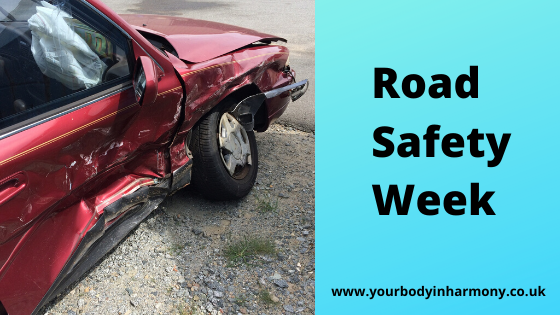
What is the leading cause of death for young people aged 5-29?
According to the Road Safety Week website:
“Every 24 seconds someone is killed on a road. More than 1.3 million people die on the world’s roads every year. Road crashes are the the leading cause of death for young people aged 5-29.”
This rather leapt out at me this morning, since I was very almost in that statistic. When I was 22, I was in a nasty car accident in which my spine was broken in 2 places and my pelvis was broken in 5 places, so that effectively my left leg was not connected to the rest of my body.
My great good fortune was that the two spinal fractures were not in places that affected the spinal cord. Yes, my neck was broken, but it was a side part of the vertebra (the left transverse process of C7 if you want to know) so not involving the spinal canal; and the lowest vertebra (L5) – below the level of the spinal cord, which finishes around waist level.
Phew. Huge phew, in fact. However it was these injuries that led to my diagnosis of severe osteoarthritis in my spine and my hips ten years later when I was 32.
What contributed to my accident? Who knows, it was late at night, it was raining, it was an unfamiliar road. My mother had missed a turning in the dark so was driving in an unfamiliar part of north London. She always says that she never saw the van that hit us. Did he have his lights on? Was there sufficient street lighting at the crossroads?
If you have been in an accident it’s always a good idea to see your GP or the local Accident and Emergency unit, if only that it is logged – and yes, it becomes part of the statistics that inform our lives, and inform the law-makers who can help to create change for the better.
As an osteopath, I find that my own experience of car accidents (yes, plural) have helped me become a better practitioner. I understand the fragility, the pain and the frustration…
I quite often treat patients who have been in car accidents – whether they were the driver, the passenger, or knocked over, or knocked off their bicycle. Their injuries can be many and various, and some can take time to emerge.
Cranial osteopathy can help to soothe unsettled nervous systems, jangled from the shock of the impact – it can help to dial down the stress response.
Tight muscles respond to gentle massage.
Stiff joints respond to the gentlest of opening out.
If you have been in an accident, warmth will help spasmed muscles to relax – you can get thin stick-on heat patches (which you can buy at pharmacies and supermarkets), that stick to your clothes, and stay warm for up to 12 hours. Very soothing (and also the singer in me finds them very helpful for rehearsing in cold churches in the winter!).
Current thinking is to NOT apply ice. When the body is injured, in the initial stages it needs the inflammatory response to help the healing process. If you need painkillers, then in the first few days paracetamol is better than ibuprofen (which is an anti-inflammatory).
As I tell my patients, this is where what I call “Christina’s 3-Day Rule” applies – lots of aches and pains can settle down after three days.
If you or your loved ones have been in an accident and things are still problematic after three days of TLC, then do get in touch with your local practitioner.
If you live or work in or near Baldock in North Hertfordshire, or Bromley in South East London, and would like to have a chat about how my gentle yet deep osteopathy might be able to help you, then do get in touch: text me or call me on 07535 350 343. I may be with a patient, so a text is best, and I can call you back.